What I Check First in a Chicago Local SEO Audit
- Written by
- Jamie Fish
- Filed
- Reading time
- 5 minutes

In this article
If a Chicago business asks me for an SEO audit, I do not start by opening a keyword tool. I start by looking at the path a real buyer would take on a phone.
Can the person find the business? Can they tell what it does? Can they see a reason to trust it? Can they call or request the next step without hunting?
That first pass usually tells us more than a giant spreadsheet. Here is the order I use before we change a headline or publish another article.
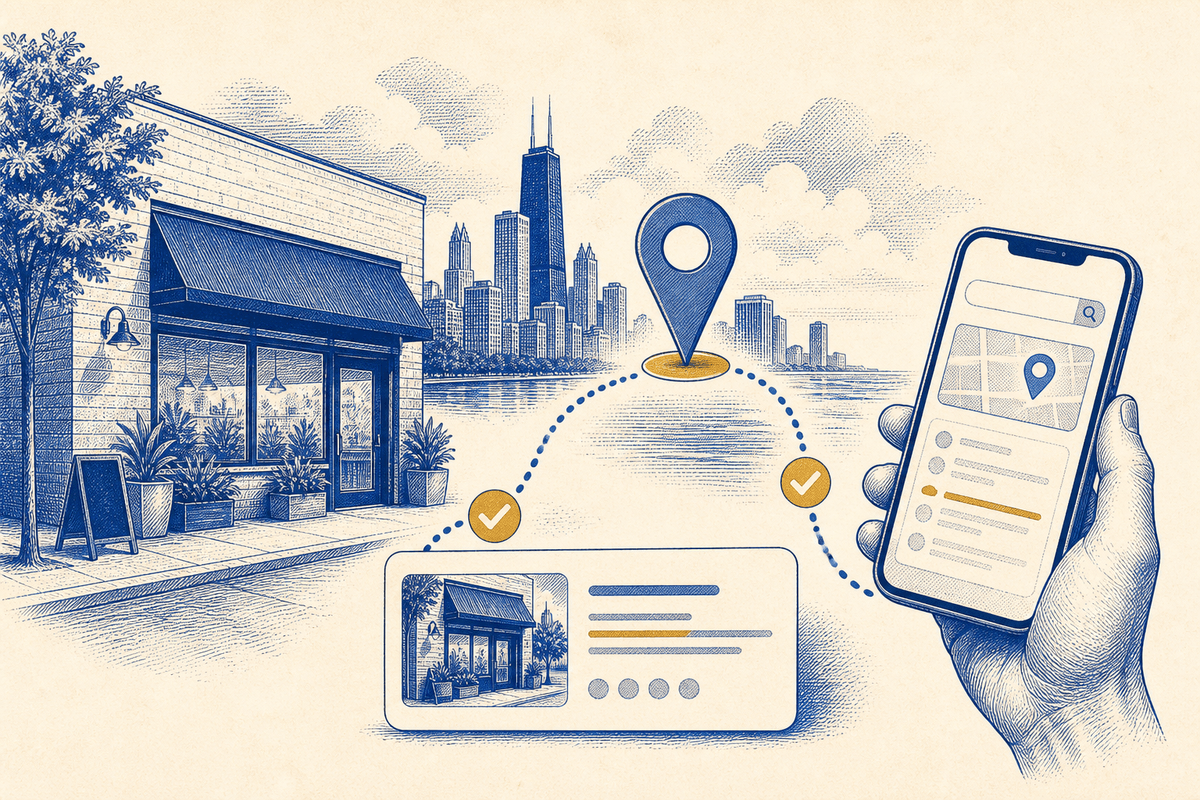
1. I check the Google Business Profile first
The profile is often the first local result a buyer sees. I check the business name, primary category, service list, hours, service area, photos, review responses, and the link back to the site.
I also look for a mismatch between the profile and the website. If the profile says one thing and the service page says another, the buyer has to do the reconciliation work. Most people will not.
The fix may be simple: a clearer category, a current service description, a better photo set, or a page that answers the same question as the listing.
2. I map searches to pages that can answer them
Chicago is not one search market. A buyer looking for local SEO, a buyer looking for a specific service, and a buyer looking for a nearby provider need different pages.
I make a short map:
- the service a buyer wants;
- the Chicago or neighborhood context that matters;
- the page that owns that intent; and
- the next action the page should make easy.
This keeps a homepage, a city page, and a service page from competing with the same generic paragraph. It also gives future articles a job: answer a useful question, then send the reader to the page built for the commercial decision.
3. I test the first ten seconds on a phone
I open the page at a narrow width and ask what a stranger sees first. Is the headline clear? Does the page explain the offer before the visitor scrolls? Does the phone number work? Is the call to action visible without fighting a sticky bar, a pop-up, or a row of tiny links?
This is where local SEO and web design meet. A search impression is useful only if the page can carry the visitor forward.
4. I look for local proof a buyer can understand
Local proof is more than adding a city name. I look for the places served, the kind of work completed, real customer stories, clear contact details, and a reason the business understands the market.
I do not turn a broad result into a percentage, a guarantee, or a timeline. If the proof is a customer story, the fact needs to stay tied to the source. If a claim needs a screenshot or a current export, I mark it for review instead of guessing.
5. I check whether we can measure the next decision
Before we call a page successful, we should know what action matters. That may be a phone call, a form, a booking, a store visit, or a useful product action.
I check the form path, phone links, analytics events, source parameters, and the handoff after someone reaches out. Clean measurement does not make a page better by itself. It tells us which change deserves the next hour.
What I can fix today and what needs time
Some changes are close to the page: a missing service link, a weak title, an unclear call to action, a broken form, or a profile detail that is out of date.
Other work needs a longer run: earning local authority, building a useful content cluster, collecting real reviews, and learning how searchers respond to the new page. No honest audit can promise a fixed position on a fixed date.
The point of the first audit is to separate the two lists so the business can act now while the longer work compounds.

My 30-day starting plan
In the first month, I would usually choose a small set of actions:
- fix the highest-friction local profile or contact detail;
- give the priority commercial page one clear Chicago job;
- connect the page to a useful proof point and next step;
- publish one supporting answer that earns an internal link; and
- record the baseline so the next review compares the same signals.
That is enough to create a clean next decision. It is also enough to tell us when the bottleneck is not the website but the offer, proof, follow-up, or authority around it.
A useful next step
If you want a Chicago local SEO audit, bring the current site, Google Business Profile, and the service that matters most. I will start with the buyer path, show you what I would fix first, and separate the work that can happen now from the work that needs a longer runway.
See the Chicago local SEO plan or start a project.
Chicago local SEO audit questions
What is included in a Chicago local SEO audit?
We review the local profile, page ownership, mobile path, proof, contact flow, and measurement setup. The output is a prioritized list of fixes and the next questions worth answering.
Does an audit guarantee a Google ranking?
No. An audit can identify gaps and a practical order of work. Rankings depend on the query, market, competitors, site quality, local authority, and how those signals change over time.
Should we fix the website or the Google Business Profile first?
It depends on the friction. I start with the part of the buyer path that is least clear or least trustworthy. Then I connect the profile and page so they reinforce each other.
Do we need a page for every Chicago neighborhood?
Usually not. A neighborhood page needs a real customer need, distinct local information, and useful proof. Thin pages that only swap place names create clutter and can compete with a stronger Chicago service page.

About the author
Jamie Fish
Founder and Web Strategist, Lakeside Web Design
Jamie helps businesses in Milwaukee and Chicago improve their websites, SEO, and digital marketing. Away from his desk, you can usually find him near Lake Michigan.
Relevant service: Chicago local SEO services
Keep reading


